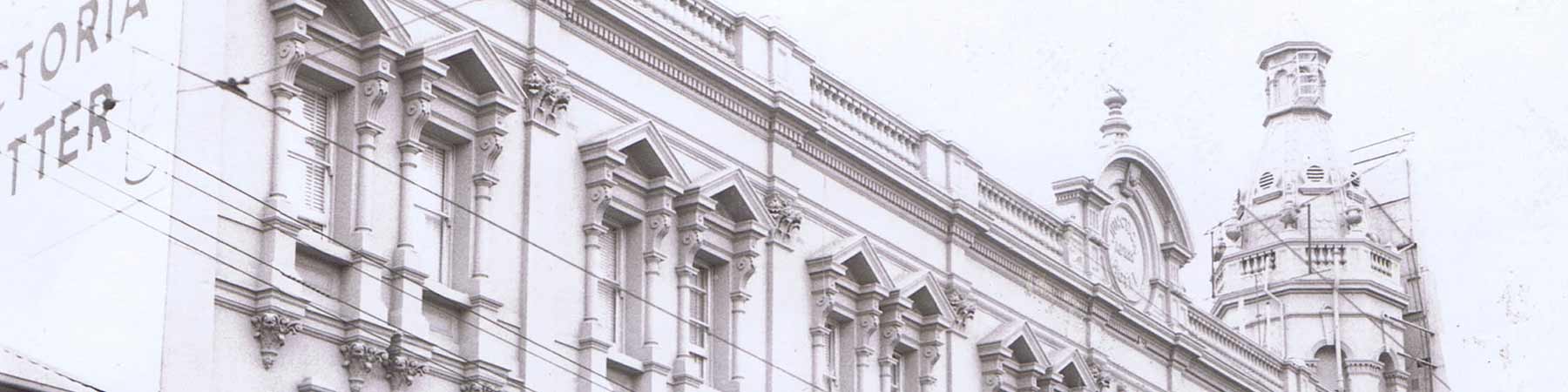
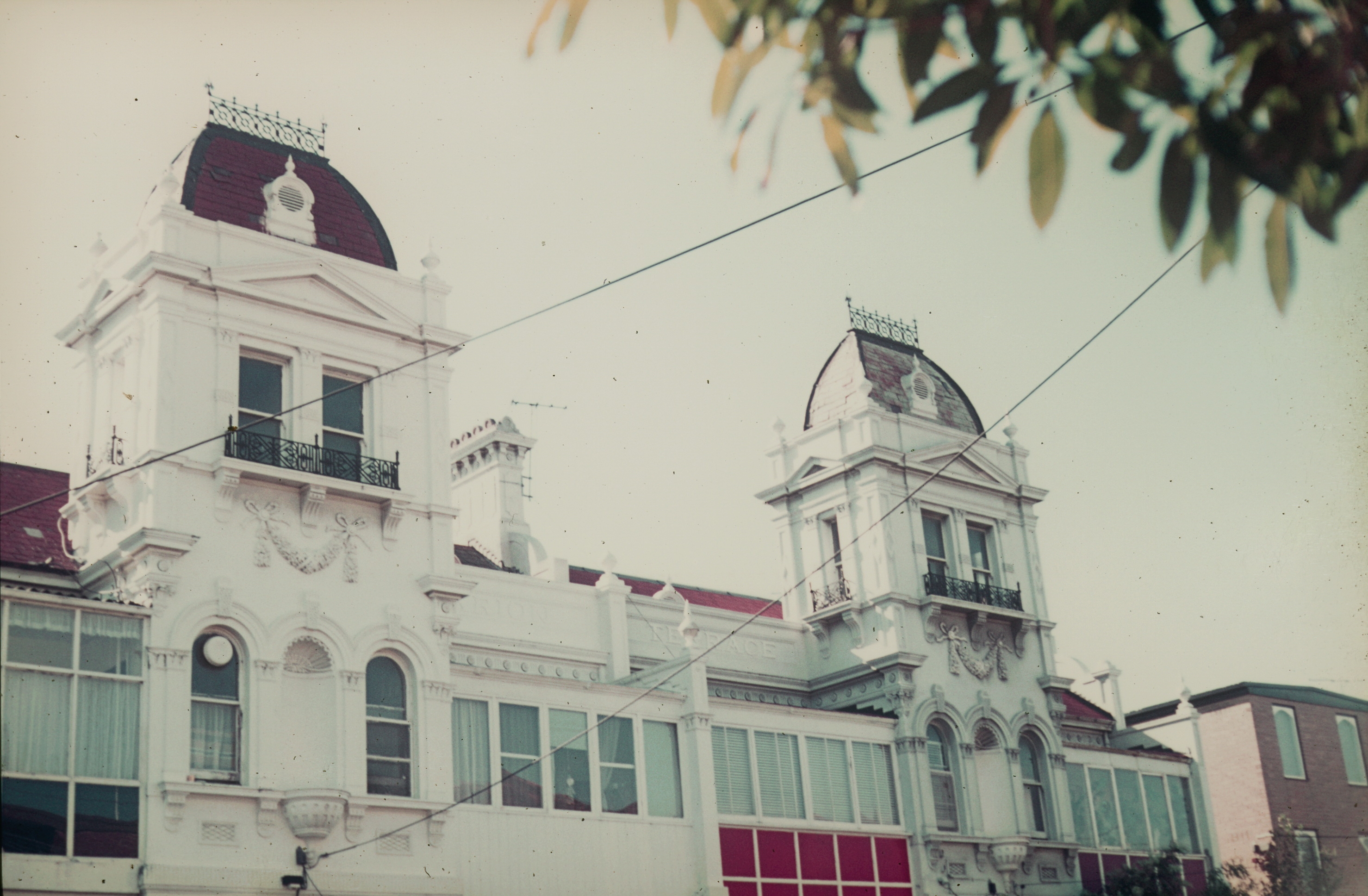
One of Melbourne's most elaborate terrace rows, built 1881-3, designed by architect Michael Egan with a pair of mansard roofed towers. In the 1960s two of the houses at the north end were replcaed by flats.
Three large blocks were originally bought by F G Dalgety in 1846, which became known as Dalgety’s Paddock. The land was subdivided in 1853 creating Burnett Street and Gurner Street, before Dalgety moved back to England.
The site of Marion Terrace is shown in the 1873 Vardy map as a 166ft block (while others were about 40ft), with a single house on the northern end of the site.
The architect of Marion Terrace was Michael Egan (1846-1912), who Roberts had previously used for work at the Victorian Trotting Club track in Elsternwick.
Egan is best known for his design for the government offices at 2 Treasury Place in Melbourne (1873), and the Torrens Building (also government offices) in Adelaide (1881), both in restrained classical style.
Marion Terrace is one of the most elaborate terrace rows in Melbourne, and it dominates Burnett Street.
The two central pairs feature projecting sections topped by shared towers with mansard roofs, giving them a French Second Empire character. These sections also feature stilted arch openings over the entrances, an arched niche above, and a pair of windows above that which share a pediment, and there is a narrower pediment on the short side. The parapet of the central two houses bears the name Marion Terrace.
The pair at nos.16-18 shar a similar feature, but instead of a tower there is a stepped Dutch pediment, adding a Queen Anne style element. The pair that are now demolished at the other end would have matched.
Between these prominent features there are verandah with cast-iron balustrades, above timber trim that incorporates coloured glass panels. The surrounds of the entry doors feature elaborate twisted colonnettes, and frieze.
The slate roofs are unusually in the form of a high transverse gable, visible from the street, with a section coming forward behind the Dutch gable, but not the towers.
All the houses are set back behind substantial gardens and cast-iron fences.
(Rohan Storey 2026)
The lot was auctioned in February 1881 and bought by merchant James Alfred Roberts. He immediately commissioned Marion Terrace as an investment, named for his wife. Roberts also commissioned Queen’s Mansions on Beaconsfield Parade in St Kilda (partly extant, very altered) and Roberts House, once situated at 20 Collins Street, Melbourne.
With inherited wealth, Roberts built a successful business empire and real estate portfolio. He was well respected in the horse racing community having launched the sport of trotting in Victoria. He had first encountered trotting in France when he was the Australian Commissioner to the 1878 Paris Exhibition.
The first tender for the terrace went out in July 1881, and on 25 November 1882 The Argus advertised "Handsome new HOUSES, called Marion-terrace, each containing nine rooms, replete with conveniences. Rent, £150."
Rate books for the years 1883-900 indicate the range of occupations of the residents : gentleman, tailor, jeweller, tea merchant, commercial traveller, artist, tobacconist, actuary, importer and numerous women whose occupation is listed as domestic duties (though in an 1883 advertisement in The Argus, Miss Samuell ‘Pianiste’ offers lessons from Marion Terrace). They also show that all houses had nine rooms (though four houses must have had an extra room in the towers).
By 1887 the terrace was owned by David Henry, and they were sold again in 1891.
A notable resident in 1894 at no 22 was Louis Abraham, of the successful tobacco firm of Sniders & Abraham. He was still living there with his wife Golda and family in December 1903 when he made the news by committing suicide while at work one day, with no apparent reason.
By the 1890s some occupants had given their houses individual names, no. 22 was Katoomba, no. 28 was Earlscourt, and no. 16 was La Mascotte.
The two northern terraces, nos. 26-28 were demolished sometime in the 60s or 70s, and replaced with a block of flats.
By then all of the balconies had been glassed in, in a variety of ways, and the original cast-iron lost, except perhaps no. 16. Some time after 1978, probably in the early 1980s, the balconies were restored, though nos. 20-24 used aluminium 'lace' in a pattern not used in the 19th century.
Typed research notes by Liam Revell provded to the Society in c2023.
Contemporary newspaper reports accessed via Trove.